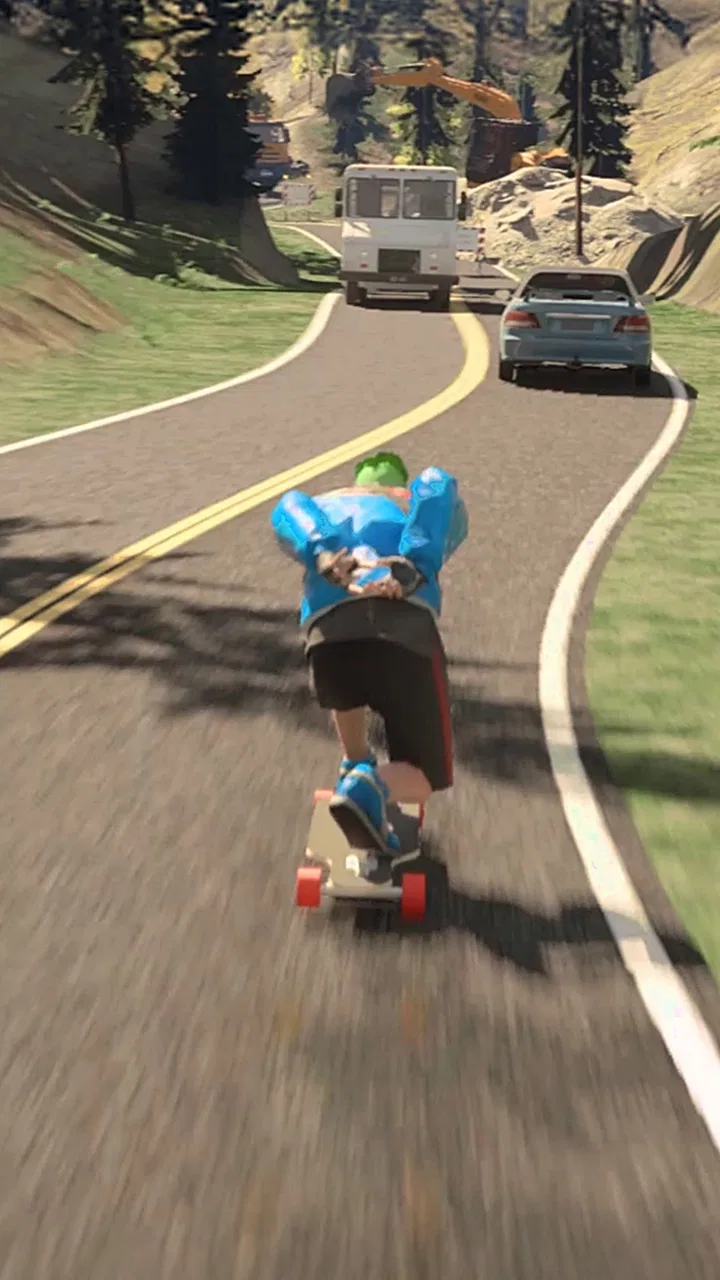
Downhill Racer
- 4.5
- Rating
- 10.00M
- Installs
- Free
- Price

 Analysis by App-foxy
Downhill Racer is the kind of arcade game I open when I want a quick burst of concentration rather than a long story, a complicated upgrade tree, or a serious simulation. The idea is immediately readable: guide a racer down steep terrain, react to the changing slope, and try to stay in control while chasing a cleaner, faster run. That simplicity is its strongest invitation, but it also means the game depends heavily on whether you enjoy repeating short challenges and improving through practice.
I found it easiest to appreciate when I treated each attempt as a small experiment. Instead of rushing to finish every descent, I watched how the vehicle responded to the shape of the hill, where I tended to overcorrect, and which moments caused me to lose momentum or control. That approach makes the arcade design feel more rewarding. The game is free to start, carries an Everyone 10+ content rating, and comes from Supercent, Inc., so it is clearly aimed at a broad audience rather than only dedicated racing fans.
How the downhill routine feels in everyday play
The basic workflow is pleasantly direct. I start a run, focus on the next section of terrain, and make small corrections instead of trying to predict the entire course at once. That matters because downhill racing creates a natural tension: moving quickly is exciting, but a careless input can ruin a promising attempt. The best runs feel less like frantic button pressing and more like finding a rhythm between acceleration, balance, and reaction.
You May Also Like

 Blood Strike: 2.5 Anniversary
Blood Strike’s Loadouts Turn Every Drop Into a Tactical Gamble
A close look at Blood Strike’s custom loadouts: how fast access to signature weapons reshapes its battle royale rhythm, rewards preparation, and narrows the gap between fights.

 Pandora - Music & Podcasts
Pandora’s Music Is Easy to Start, but Harder to Recover
Pandora’s strength is its low-effort path from a seed to a station. Its weak spot is how much confidence it asks you to place in connection, setup, and quiet recovery.

 8 Ball Pool
 Is Built on Rivalries, Rematches, and Routine
A close look at the rivalries, rematches, shared routines, and unanswered safety questions that turn a quick pool match into a persistent mobile community.

 Samsung Music
’s Quiet Strength Is Playing What You Already Own
Its reach comes less from spectacle than from dependable access to a personal library. That simplicity is both the app’s strongest retention engine and its ceiling.

 AccuWeather: Weather Radar
AccuWeather Review: A Quick, Clear Forecast for Everyday Decisions
For everyday plans, the best forecast is the one you can understand quickly. AccuWeather makes rain timing, radar, and local conditions easy to act on, with a few trade-offs.

 Hill Climb Racing
Why Hill Climb Racing Still Turns Crashes Into One More Run
A tiny car, a bumpy hill and one more upgrade: Hill Climb Racing keeps resurfacing because its simple chaos makes every near-miss feel personal.
More From Our News Desk



For a normal everyday scenario, I can see myself playing during a short break, waiting for an appointment, or taking a few attempts after finishing a task. A single run does not require the commitment of a full racing event, and the controls are easy enough to understand without studying a manual. The real time commitment comes from wanting to retry a section after a mistake. If you are comfortable with “one more attempt” games, that loop works well.
I would not choose it when I want realistic motorsport handling, licensed cars, detailed tuning, or long-form competition. A conventional racing game is a better fit for players who want recognizable tracks, strategic pit decisions, or a deep career structure. Downhill Racer is more focused: the hill is the obstacle, your timing is the main tool, and the satisfaction comes from gradually becoming less wasteful with each attempt.
The game’s strong public reception helps explain why it has reached a wide audience. It holds a 4.6 average from around 441 thousand ratings, and its install count has passed 10 million. Those figures do not guarantee that every player will enjoy the design, but they do suggest that the quick downhill format has broad appeal. In my experience, its accessibility is real, although the later challenge comes from precision rather than from learning a large number of systems.
Start with a repeatable baseline instead of chasing speed
My first useful habit was to establish a safe baseline. I stopped trying to make every descent as fast as possible and concentrated on completing the route with fewer mistakes. This gives you a reference point: you can tell whether a new approach genuinely improves the run or merely feels faster before ending in a crash or a poor finish.
That baseline is especially useful for players who tend to react emotionally after a mistake. A failed attempt often encourages a stronger correction on the next run, which can create another failure in the opposite direction. I get better results by identifying the exact moment where control was lost, then changing one thing on the next attempt. Smaller changes make the game’s feedback easier to read.
Another practical habit is to divide a descent into visual sections. I pay attention to the approach, the steepest part, and the exit rather than treating the whole hill as one continuous problem. The approach is where I prepare; the steep section demands restraint; the exit is where I try to recover speed without throwing away the run. This mental division makes the action feel more manageable without requiring any extra game system.
Players wondering whether they need a powerful modern phone should find the minimum requirement approachable: the game supports Android versions from 6.0 onward. Actual comfort will still depend on the device, screen size, and responsiveness, but the stated baseline makes it suitable for many older Android phones and tablets. I would test touch response before committing to long sessions, because precise corrections matter more here than elaborate graphics settings.
Settings and session habits worth checking
I recommend checking the available settings before settling into serious attempts. I do not treat this as busywork: a control option that feels slightly wrong can make a simple downhill game seem unfair. If the game offers control or audio adjustments on your device, I would choose the arrangement that lets your thumb make short, repeatable movements and keep the important part of the screen visible.
For touch play, I prefer holding the phone securely and using a light grip. A tight grip makes quick corrections less consistent, especially when the game suddenly demands a change in direction. I also avoid playing with a finger that is damp or obstructing too much of the display. These sound like small details, but a game built around immediate reactions exposes them quickly.
Sound is worth considering as well. I usually keep enough audio to recognize the pace of a run, but I lower it when playing in public or when I need to concentrate without distraction. If you are using the game as a quiet break, turning down unnecessary audio can make repeated attempts less tiring. If you enjoy arcade feedback, keeping sound on may help each run feel more connected to your inputs.
The game is free, but in-app purchases range from $3.99 to $9.99 per item. I would begin without buying anything and first decide whether the core downhill loop holds my attention. That is not just a money-saving suggestion; it also gives a clearer sense of whether your progress comes from improved control or from an optional convenience. Players who dislike purchase prompts should be prepared to manage that part of the experience carefully.
Version 31.2.0 is the current version, so I would keep the installation updated through the normal store process when possible. Updates can matter for stability and compatibility, particularly on older devices. I would also avoid judging the game from a single rushed session after an update; a short adjustment period can make controls feel different simply because your hands have not yet settled back into the rhythm.
Patterns that make attempts faster and cleaner
The most useful speed pattern I found is to separate steering from panic. When the terrain changes sharply, my first instinct is often to make a large correction. That may feel active, but it usually gives me less control. A better pattern is to make the smallest correction that keeps the racer aligned, then reassess immediately. This preserves options and makes the next decision easier.
I also try to enter difficult sections with a plan rather than improvising at the last instant. If the upcoming slope looks demanding, I prepare my position before reaching it. The goal is not to eliminate reaction; it is to avoid spending the entire difficult section recovering from an earlier mistake. Experienced play feels calmer because preparation reduces the number of emergency inputs.
One non-obvious trade-off is that the fastest-looking line is not always the fastest complete run. A risky approach may produce a burst of speed, but losing control forces a restart or costs more time than a cautious line would have. I judge a route by how often I can reproduce it, not by the best result I achieved once. Consistency is the hidden advantage in an arcade game built around repeated descents.
Another useful routine is to change only one variable between attempts. I might alter my entry position, then keep the rest of the approach similar. If I change direction, timing, and grip all at once, I cannot tell which decision helped. This method is slower emotionally, but faster for learning. It turns repetition into information instead of a sequence of nearly identical guesses.
When I am trying to improve, I use short practice blocks rather than playing until every attempt feels worse. Fatigue makes corrections larger and less deliberate. A few focused runs followed by a break are more productive than continuing through frustration. This is particularly relevant for younger players and for anyone using the game as a casual distraction rather than a competitive challenge.
Where the simple design reaches its limits
Downhill Racer’s focus is also its main limitation. If you need a large variety of vehicles, extensive customization, a story campaign, or a realistic racing model, this will probably feel light. The game asks you to master movement and terrain, not to manage a full racing career. That narrow purpose is refreshing for short sessions, but it can become repetitive for players who need constant new systems to stay interested.
The control challenge may also divide people. Some players will enjoy the precision because every improvement feels earned. Others may interpret failed runs as frustrating, especially if they prefer forgiving arcade handling. I would recommend it to someone who likes retrying a tricky sequence, but not to someone who wants to relax with almost no chance of failure.
There is a practical difference between playing casually and playing for mastery. Casual players can enjoy the immediate downhill action without analyzing every movement. Advanced players, however, will eventually notice that progress depends on disciplined habits: stable grip, small corrections, planned entries, and consistent repetition. Once those habits become automatic, the game feels more satisfying, but reaching that point requires patience.
The age rating of Everyone 10+ makes the game suitable for a broad audience, although parents should still remember that free games with in-app purchases deserve normal purchase controls on a shared device. I would not hand a child a payment-enabled phone without checking those safeguards first. That is less about the racing itself and more about making the free-to-start model comfortable for the household.
Players also ask whether it is better suited to Android or iOS. The important question for me is not the platform label but the quality of touch response on the particular device. A larger screen may make the terrain easier to read, while a compact phone can be more convenient for quick sessions. I would choose the device where your thumb feels most accurate, because that affects play more directly than the platform name.
Who should install it and who should skip it
I recommend this arcade game to players who enjoy short, repeatable challenges and like seeing their own technique improve. It is a good match for someone who wants a racing-flavored game without learning a complicated control scheme. It also works for people who enjoy testing small changes, because the downhill format gives immediate feedback when an approach is too aggressive or too cautious.
I would be more cautious if you are looking for social competition, a detailed progression system, or a simulation with realistic vehicle behavior. Those expectations may make the game seem underdeveloped even when its focused design is working as intended. Likewise, if repeated retries quickly bore you, the central loop may not provide enough variety to justify a long-term place on your phone.
Compared with endless runners, the appeal here is the stronger sense of steering and terrain management. Compared with traditional racing games, the sessions are lighter and the focus is narrower. Compared with physics-heavy stunt games, the experience is less about creating spectacular accidents and more about completing a controlled descent. I prefer it when I want a compact skill test, while I would choose a full racing title for variety and a runner for completely effortless play.
My verdict after settling into the rhythm
The best way to enjoy Downhill Racer is to treat control as a skill, not as a button-mashing contest. Once I stopped forcing speed and started building repeatable patterns, the game became more engaging. Preparing for difficult slopes, limiting corrections, and reviewing one mistake at a time gave the simple format more depth than its short description suggests.
Supercent, Inc. has made a free arcade game that is easy to approach but not automatically easy to master. The broad audience, modest Android requirement, and quick-session structure make it convenient, while the optional purchases mean I would play for a while before deciding whether anything extra is worthwhile. Its 31.2.0 version keeps the product current, and the large player base shows that the concept has connected with many people.
My final recommendation is straightforward: install it if you want fast downhill runs and enjoy improving through repetition. Start with safe completions, check your control comfort, and only then chase faster lines. Skip it if you need deep customization, realistic racing, or constant novelty. For the right player, Downhill Racer is a focused little arcade challenge whose strongest moments come when a chaotic-looking hill finally becomes predictable.
FAQs for Downhill Racer
01What is Downhill Racer?
Downhill Racer is an exhilarating mobile game that simulates the thrill of downhill skiing. Players navigate through challenging courses, dodging obstacles and performing tricks to earn points. With stunning graphics and realistic physics, it offers an immersive experience for both casual players and skiing enthusiasts.
02Is Downhill Racer free to play?
Yes, Downhill Racer is free to download and play. However, it includes in-app purchases that allow players to buy additional features, such as special equipment, ad-free gameplay, and exclusive levels. This setup ensures that players can enjoy the game for free while also offering ways to enhance their experience.
03What are the system requirements for Downhill Racer?
For Android users, Downhill Racer requires Android 5.0 and up, while iOS users need iOS 11.0 or later. It is compatible with most modern smartphones and tablets, but for optimal performance, a device with a recent operating system and sufficient RAM is recommended.
04Does Downhill Racer require an internet connection?
Downhill Racer can be played offline, allowing users to enjoy the game without an internet connection. However, certain features, such as leaderboards and daily challenges, require connectivity. For the best experience, it is recommended to play online to access all features and updates.
05Are there any accessibility features in Downhill Racer?
Yes, Downhill Racer includes several accessibility features to enhance playability. These include customizable controls and adjustable difficulty settings. The game also supports colorblind modes and offers audio cues for visually impaired players, ensuring a more inclusive gaming experience.
Pros
- Intuitive controls enhance gameplay immersion.
- Vibrant graphics create a stunning visual experience.
- Multiplayer mode adds competitive excitement.
- Wide variety of tracks keeps gameplay fresh.
- Smooth performance on both Android and iOS.
Cons
- In-app purchases can become costly.
- Requires a stable internet connection.
- Occasional glitches in multiplayer mode.
- Limited customization options for characters.
- Advertisements can be intrusive at times.

Downhill Racer
Gallery